
How 3D Printing Could Bend The Cost Curve In Healthcare
MATERIALS AND METHODS
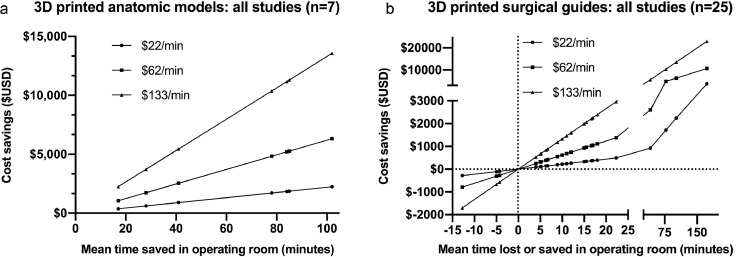
A targeted literature search identified operating room cost-per-minute and studies that quantified time saved using 3D printed constructs. Studies that reported operative time differences due to 3D printed anatomic models or surgical guides were reviewed and cataloged. A mean of $62 per operating room minute (range of $22–$133 per minute) was used as the reference standard for operating room time cost. Different financial scenarios were modeled with the provided cost-per-minute of operating room time (using high, mean, and low values) and mean time saved using 3D printed constructs.
RESULTS
Seven studies using 3D printed anatomic models in surgical care demonstrated a mean 62 minutes ($3720/case saved from reduced time) of time saved, and 25 studies of 3D printed surgical guides demonstrated a mean 23 minutes time saved ($1488/case saved from reduced time). An estimated 63 models or guides per year (or 1.2/week) were predicted to be the minimum number to breakeven and account for annual fixed costs.
CONCLUSION
Based on the literature-based financial analyses, medical 3D printing appears to reduce operating room costs secondary to shortening procedure times. While resource-intensive, 3D printed constructs used in patients’ operative care provides considerable downstream value to health systems.