
Surgeons Can Observe Accuracy, Precision & Shorter Operating Time Using Virtual Surgical Planning
In the case of this surgery, performed by Deepak Krishnan, DDS, of Cincinnati’s UC Health, the patient presented with a unilateral cleft lip and palate. The patient was diagnosed with maxillary hypoplasia, mandibular hyperplasia, and facial asymmetry resulting in the inability to chew properly, poor speech, and disfigurement.
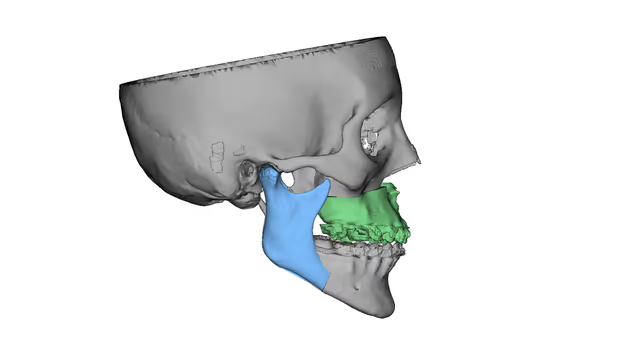
Double-jaw surgery was scheduled and pre-planned using 3D Systems’ VSP Orthognathics service. According to Dr. Krishnan, the use of VSP contributed to improved surgical planning, an efficient transfer of the pre-operative plan into the operating room, and reduced operating time.
The digital 3D models that serve as the foundation of VSP provide clinicians with a more complete view of the intrinsically unique anatomy of each patient. This enables the presiding surgeon to accurately visualize and analyze patient-specific anatomical discrepancies, explore multiple treatment options for each patient, and visualize, anticipate and prepare for possible surgical obstacles prior to beginning the surgery.
Image Processing with D2P Software
Dr. Viha Preetha referred the patient for a CBCT (cone beam computed tomography) scan of both maxilla and mandible with less than 0.6 mm slicing thickness. She rendered the image in DICOM (digital imaging and communication in medicine) and then converted it into an STL file using D2P software from 3D Systems, which provides precise information including bone density and soft tissues and has a United States FDA 510(k) device clearance, European Economic Area (EEA) CE mark, and Israeli AMAR for medical use. Using D2P, she extracted the exact amount of bone exposed during CBCT radiation to perform an accurate and minimally invasive osteotomy.
Surgical Planning and Designing with Geomagic Freeform Software
Next Mr. Iraimudi virtually planned and designed customized subperiosteal implants for every step of the procedure using Geomagic Freeform software and a Touch haptic device.
Mr. Iraimudi imported the converted STL file into Geomagic Freeform as an exact virtual replica of the patient’s jaw. He then used Geomagic Freeform and a Touch haptic device to design the implant framework accurately for location, length, depth, and angle using the interocclusal distance to position the abutment length and angulation for the prosthetic replacement.